Showing posts with label invention. Show all posts
Showing posts with label invention. Show all posts
Sunday, May 6, 2012
Residential roadway volume control
Having recently moved back to the Tri State, I am woken up several times a night by wailing sirens. I live in the downtown area, so I figure the ambulances and police are driving through since its the most logical path through downtown. So anyway here is my suggestion. You know how on the highway there are those special walls that are built to take sound waves and deflect them back across the highway at the grooved walls so that the sound doesnt escape the horizontal span of road. Well, imagine that in a residential area, perhaps built into the walls of homes - deflecting the sound waves, and at the top some sort of mirrored triangulation to capture the waves and stop them from rising, like a top covering (twisting/curving/bending sound waves), so you have a 50 ft by 50 ft box, which contains the sound waves force_field_ed to street area. This way the sirens noise is only bothering those who it is pertinent for, drivers who need to get out of the way.


Tuesday, June 7, 2011
proximity geo connector

Another mode would be a livefeed videochat, where users who are signed in (broadcasting from front facing cameras) again, are shown in a randomized mosaic 'videos cloud' based upon proximity location and interests-wise, which determine the size of the scattered thumbnails.
The prog would algorithmically pair, as well as visually display these 50 users via tag / location sensitivity. If you already know someone, you remove them from the scattered 'introduction' mosaic; which then populates with new people.
Users are rightfully daunted by the anonymous nature of the web. There is no way to substantiate the face behind the profile. The way it works now, like on Facebook, is that only after you meet someone do you connect to them via the web. This is a more human-faced approach to inspire local micro-networking.
Thursday, May 5, 2011
Semi-automated Prison System utilizing moving walls
One way to cut down on prison maintenance costs, as well as cutting down on prison violence, would be to fully automate the processing of prisoners from the minute they enter, through daily tasks, to the final exiting of the prison (apologies for the cattle-like language usage). And while most prison facilities have some form of computerized automation, most still require human involvement in mundane tasks, mainly involving the movement of prisoners around the system, leading to dangerous situations for both the guards as well as the prisoners themselves.
The proposed semi-automated prison system consists of a number of drop-in cubicle-like pods: general living quarter pods, hygiene pods (shower & sink), and could even be amended with leisure pods: computer-based library pod, gym pod, etc. These pods run on rails and are dropped into place as needed, similar to the cubes presented in the movie "Cube", only less booby-trapped. Consider the following scenarios:
• Prisoner gets to use the showers at 7am every day. However, for whatever reason, the prisoner refuses to move from his/her cell. A system operator realizes this, and activates the moving walls that gently nudge the person in the direction of the cell door. The shower pod gets lowered into place before the cell door opens, allowing the prisoner to use the facilities.
• Prisoner has completed a given task, and is rewarded for the completion by dropping the gym pod into place.
• Prisoner is a model "guest", and has earned extra-special privileges: A pod replete with small patch of grass, tree/shrubs, simulated bird song, and a window with a view of the sky is lowered into place.
• A prisoner has died. The moving walls activate, shoving the deceased into a waiting incineration pod.
The proposed semi-automated prison system consists of a number of drop-in cubicle-like pods: general living quarter pods, hygiene pods (shower & sink), and could even be amended with leisure pods: computer-based library pod, gym pod, etc. These pods run on rails and are dropped into place as needed, similar to the cubes presented in the movie "Cube", only less booby-trapped. Consider the following scenarios:
• Prisoner gets to use the showers at 7am every day. However, for whatever reason, the prisoner refuses to move from his/her cell. A system operator realizes this, and activates the moving walls that gently nudge the person in the direction of the cell door. The shower pod gets lowered into place before the cell door opens, allowing the prisoner to use the facilities.
• Prisoner has completed a given task, and is rewarded for the completion by dropping the gym pod into place.
• Prisoner is a model "guest", and has earned extra-special privileges: A pod replete with small patch of grass, tree/shrubs, simulated bird song, and a window with a view of the sky is lowered into place.
• A prisoner has died. The moving walls activate, shoving the deceased into a waiting incineration pod.
Sunday, April 24, 2011
Systemwide self-learning data input correction
This notion comes to mind via speech recognition, but it applies to any platform where multiple inclusive functions correlate. I notice on my android phone that I am constantly correcting the voice to text output. The same mistakes occur over and over. My idea is for the speech software to notice the type of text edits I am retyping, and utilize that data to amend it's own errors for future voice scanning. If it could learn from my corrections, and thereby tweak itself to be more in tune with me, by anticipating my intent -next time it wouldn't keep making those same errors. Subtagged: Machine Learning, Natural Language Processing Technologies, Speech segmentation, Speech recognition
Saturday, April 23, 2011
Posthumous post
This is an idea for a website, which allows users to verify their identity, and gives them a platform to input text, images, and video into a profile page. This would be released posthumously and only made public upon the user's confirmed death. This would be a great way to share some final intimate feedback with the world that you otherwise might be uncomfortable to share, and it would be an official last statement that could be read at one's funeral. I am pretty sure that a legal will can't occur online, but this is more of a lighthearted sharing time capsule. Another cool use of this would be that if you deal with someone shady, you could note it, or there could even be a cellphone app add-on which logs your GPS. This way in the case of unnatural death, the data could help police investigations.
Tuesday, April 12, 2011
Hypothesis about the purpose of bugs and plantlife
When you zoom in on bugs, they definitely exhibit some traits reminiscent of humans, like physical structure (arms, legs, face), eating/defecating loop, behavior patterns, struggle for survival. We rightly should feel bad when squishing a bug, if not alone for the wasting of meticulous technology and nature's creation. Maybe there could be an eventual significant usage for this overbearing presence in our atmosphere.
At present our relationship with animals is as 'pets' (irrational beasts with fangs), or seeing-eye dogs, or simply the quest to exterminate bugs, so we invent dog collars, and mosquito shock lamps and restrict the bugs from our boundary, which results in them getting tazed or poisoned.
 Imagine a future where bugs are controlled by manipulated airwaves, or maybe a mobile app that emits specific tonal patterns. The bug's mind is re-programmed and delegated with a task suited for it's composition. All bugs would be programmed not to harm humans, so if you saw one, you wouldn't be freaking out, but rather assuming your technology would provide it with a flight-plan of usefulness, and take into account the bugs feeding and survival! Some of my intended usage for the bugs:
· A wall of bugs standing guard at a certain GPS parameter.
· Utilizing bugs to observe and report for other dangers or climate concerns.
· Use bees to enrich and balance weather patterns.
· Repair the ozone, etc.
Similarly, plantlife could be algorithmically contoured, (mashed-up, grafted, DNA spliced) to be custom grown to conform to specific moldings for product manufacturing purposes (speed growing custom designed lumber), or for personal useage, such as a small flower or plant, which is built in sync with your personal DNA, to provide specific nutrients based on individual medical shortcomings, and taste preferences.
At present our relationship with animals is as 'pets' (irrational beasts with fangs), or seeing-eye dogs, or simply the quest to exterminate bugs, so we invent dog collars, and mosquito shock lamps and restrict the bugs from our boundary, which results in them getting tazed or poisoned.
 Imagine a future where bugs are controlled by manipulated airwaves, or maybe a mobile app that emits specific tonal patterns. The bug's mind is re-programmed and delegated with a task suited for it's composition. All bugs would be programmed not to harm humans, so if you saw one, you wouldn't be freaking out, but rather assuming your technology would provide it with a flight-plan of usefulness, and take into account the bugs feeding and survival! Some of my intended usage for the bugs:
 · A wall of bugs standing guard at a certain GPS parameter.
· Utilizing bugs to observe and report for other dangers or climate concerns.
· Use bees to enrich and balance weather patterns.
· Repair the ozone, etc.
Similarly, plantlife could be algorithmically contoured, (mashed-up, grafted, DNA spliced) to be custom grown to conform to specific moldings for product manufacturing purposes (speed growing custom designed lumber), or for personal useage, such as a small flower or plant, which is built in sync with your personal DNA, to provide specific nutrients based on individual medical shortcomings, and taste preferences.
Friday, March 11, 2011
Type tone
Using alpha numeric keyboards or telephone number buttons - to transmit information instantaneously. So that in billing situations, you don't need to to shout out your personal details for 10 minutes. Rather I ought to be able to input and transmit this data with my telephone or PDA keyboard, in a non obtrusive way (no loud tone noise for the receiving party). The info should instantly appear in on their monitor. This sort of exists with automated phone ordering systems, but that's not as seamless as it could be.
Thursday, March 10, 2011
Underwater enclosure bubble

Saturday, March 5, 2011
Gel-padded luggage
Here is an idea for transporting delicate electronics (like a large CPU) in the airplane cargo. Buy an oversized hard shell suitcase. Fill with gel foam padding (same material as the wrist-pad gel protector) 3 inches thick, bracketed to the inside of the suitcase shell, when the metal CPU is placed inside, if the suitcase is thrown 2 feet in the air, when it lands on that thick gel, it should cushion the impact.
Wednesday, March 2, 2011
biomed wetware

 This isn't an idea inasmuch as a prediction of where advances in medicine will lead. Imagine a tiny digital control board in your arm [or cellphone], where you control levels of vitamins, chemical balances, dopamine, via an mini bio-organ unit buried inside of the humans solarplex. It would be just like an egg puzzle, with compartments of various size, that spin and slide around to reach an exit opening and pour out their contents into the humans bloodstream. Just as a soft drink machine has tubes lined up to output different flavors. The tiny computer unit would primarily diagnose and blood-test/detect for an imbalance (potassium, blood sugar, adrenaline, etc), and then immediately react with medication (from it's "mini pharmacy") by fauceting out very potent chemicals / vitamins to correct said blood levels, in a manner more intensely focused, than a sporadic 8 hour dose pill. Subtagged: Bionanotechnology, Nanobiotechnology
Monday, January 17, 2011
Insta-feedback audience
(This idea stems from my previous post; temple diodes). TV show rating reportings / statistics are sharpening with the advent of new technology (digital GoogleTV), so these metrics can be better quantified. I think that the audiences capacity to anonymously like/dislike shows will become more apparent thereby reflecting future programming. Imagine in the center of the audience of a talkshow, is a robot (3 times the size of a normal human) sitting there. The face of the bot is programmed to show basic emotions. It would be controlled via viewers in their private homes. Based upon how funny or unfunny the show is, this audience robot, would react. Thus providing an instantaneous indicator of feedback to the show host. I think this idea came from watching Spartacus, where he is forced to fight to the death in a Roman amphitheater because that's what the audience wanted, but when cornered, an audience member wouldn't admit to wanting to see that. So the anon nature of reporting metrics could push pop media into a funny place with this robotic feedback... /random
Tuesday, January 4, 2011
veggie carbohydrate desserts
I recall hearing food inventors producing vegetarian tofu with the exact texture and crunch of real chicken meat. What about potato cookies and tuna fish cake?
'What we are hungry for' is controlled by our mood and hormones as opposed to the body. The stomach signals for hunger are because of the body's need for vital nutrients, yet statistically chocolate is the most commonly craved food in the United States (conditioned subconscious Pavlovian taste aversion).
People crave items high in fat and calories, since fatty, sugary foods, which are not even hunger satiating, release opioids into our bloodstream which bind to brain receptors and provide feelings of pleasure and mild euphoria.
Maybe we could eat healthy food at the same time as outsmarting the mind's food cravings by enjoying vegetables engineered to look and taste like cookies.
'What we are hungry for' is controlled by our mood and hormones as opposed to the body. The stomach signals for hunger are because of the body's need for vital nutrients, yet statistically chocolate is the most commonly craved food in the United States (conditioned subconscious Pavlovian taste aversion).
People crave items high in fat and calories, since fatty, sugary foods, which are not even hunger satiating, release opioids into our bloodstream which bind to brain receptors and provide feelings of pleasure and mild euphoria.
Maybe we could eat healthy food at the same time as outsmarting the mind's food cravings by enjoying vegetables engineered to look and taste like cookies.
Saturday, January 1, 2011
un chore-ize teeth brushing
 I hate to stand still for 5 minutes when brushing my teeth. I hate the burning of toothpaste /mouthwash, and my arm needs to get wet. My whole presence needs to be disrupted and genuinely annoyed by this necessary task.
50 years into the future I bet there will be a contraption built like a mold, to slot around two sets of teeth, with many tiny bristles built into it’s walls on mini revolvers. This contraption would have tiny jetstreams of water, a quarter inch away from the tooth, so it could just fit inside the mouth. The contraption contains just the right fit/ amount of pressure /release of toothpaste equally, and has the ergo/aero dynamics necessary to slip in and out of the mouth, 30 seconds later to a fresh maintained cleaning. Photo via neatorama
Monday, December 27, 2010
Electronically melt snow
The news is talking about how this blizzard is shutting down the roads, and I wonder about an electronic method for deleting the ice. Imagine teabags full of dry magnesium chloride flakes or pellets, blown around a caged box. Each teabag would by sized too big to pass through the caged grating, and also contain a magnet of specific polarity. The idea is to keep the particles in motion and fan blow the teabags around this caging, thus creating a 12 foot wall that passes through the airwaves and is driven through the streets, so that as the salt passes through the air at random, a wide range of area is dispersed with the chemical salt like a large melting blanket. The unit would affix to a snow plow, (possibly behind the plow) and as it passes through the air, would best disperse the salt. I realize that salt prevents ice from freezing, and it doesn't magically melt snow. My idea is to better mix-in the ratio of particle coverage, as well as speculate aloud in hopes of inspiring a potential solution.
Wednesday, December 8, 2010
brain-controlled warm weather
One of the things that blows about winter is the cold clammy, rigid, sticky-dry feeling of moving your joints / muscles against cold shirt fabric. In situations where I am outdoors or in a big space without great heating, I wish there was a pill I could take that would trick my brain into feeling warm and ignore the coldness in the room and on my skin.
Drinking liquor or alcohol to stay warm actually only tricks you into feeling warm, while it actually makes surface blood vessels open wider. This changes the blood flow and causes the core to lose heat faster. You will feel warmer but actually be getting colder.
Could the brain be chemically programmed to temporarily think and feel like the weather conditions weren't quite as cold. This would take the edge off and make an annoying situation one is stuck in anyway -more comfortable. I am not talking about a hypothermia risk, all I need is for my brain think that it is 10-20 degrees warmer. It seems more economical to turn up the heating thermostat neurologically. And from what I've read, the (moderate) cold weather helps immunity.
Drinking liquor or alcohol to stay warm actually only tricks you into feeling warm, while it actually makes surface blood vessels open wider. This changes the blood flow and causes the core to lose heat faster. You will feel warmer but actually be getting colder.
Could the brain be chemically programmed to temporarily think and feel like the weather conditions weren't quite as cold. This would take the edge off and make an annoying situation one is stuck in anyway -more comfortable. I am not talking about a hypothermia risk, all I need is for my brain think that it is 10-20 degrees warmer. It seems more economical to turn up the heating thermostat neurologically. And from what I've read, the (moderate) cold weather helps immunity.
Sunday, December 5, 2010
thermo indicator on metal cookware
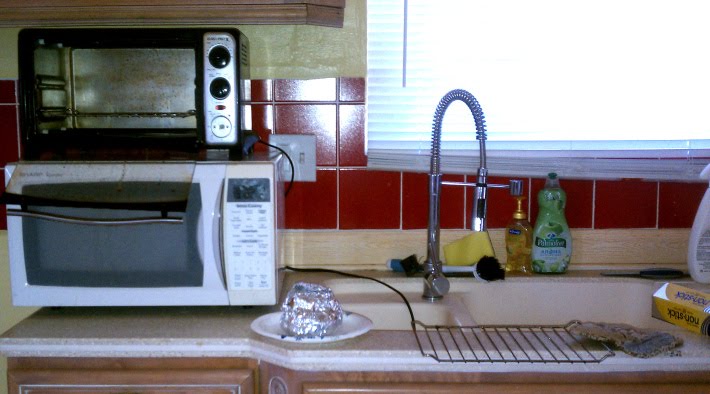
When baking in the oven, once the food is cooked and on my plate, I put back on the oven mitt, and place the hot metal baking sheet back inside of the oven -to cool off. The reasoning for this is because if someone else in the house, happens upon the kitchen and touches the cookie sheet, they'd get singed. This may already exist, but anyway, my idea was for a cheap thermo indicator to be embedded into the side or rim of the metal cookie sheet. Preferably with a blue/red light diode to indicate cold/hot, or a thermometer to signify the temperature of the metal. Sort of like how some AA batteries have a power indicator that you push with your thumb. Only this one is meant to indicate 'not to touch'.
Ideally the whole metal grill/rack piece should change color to red when the temp is hot enough to burn human flesh...
The next application of this would be a sink faucet having an LED on the top of the spout, which indicates the heat level of the water coming out.
Tuesday, October 26, 2010
Hydrophobic food packaging
We've all seen those dishwasher tabs that are enclosed in a clear, slightly sticky see-thru plastic which dissolves upon contact with water in the dishwasher. Why not apply the same principle to food packaging?
Take ramen packaging: With the whole thing (ramen and spices) enclosed in hydrophobic packaging, you could throw it in boiling water, hey presto, 5 mins later the packaging and the little sachet holding the spices have dissolved. Easier to manufacture, less environmental impact, AND it's quicker and easier to cook!
Bonus points for inventing flavored packaging, so you end up with even less packaging materials.
Patents pending.
Take ramen packaging: With the whole thing (ramen and spices) enclosed in hydrophobic packaging, you could throw it in boiling water, hey presto, 5 mins later the packaging and the little sachet holding the spices have dissolved. Easier to manufacture, less environmental impact, AND it's quicker and easier to cook!
Bonus points for inventing flavored packaging, so you end up with even less packaging materials.
Patents pending.
Wednesday, November 25, 2009
Cipher Drinking glass

An empty glass resembles a meaningless colorful mosaic, until a liquid is poured into it, revealing its name. Each side of the glass is reserved for a specific drink.
The Dekrypt glass though complex in appearance in fact runs on a very simple idea. Differently colored shapes are scattered across the glass surface in a seemingly random pattern, however their position is hardly accidental. The true purpose of the glass mosaic is revealed when colored liquid is poured into it (orange juice, milk, Nescafe or coke) The pattern of shapes and empty spaces on the glass combined with the color of the liquid inside the glass end up forming a textual sign, revealing what exact drink or refreshment you are having, with each side of the glass reserved for a specific drink. Besides being a novelty item with entertainment value it can also serve as a marketing item for beverage companies as it has a promotional potential.
Idea by: relogik.com/cipher
Saturday, November 14, 2009
Mousepad mouse
 My idea is for a mousepad sized (large size) touchpad (like the little mouse touchpad on laptops). On the left and right side, there would be a slider which zooms scale in or out, so the user could comfortably scroll/navigate closer to their intended destination - at the same time as zooming-in or out.
Disclaimer: this probably exists already, but since I am not sure, I am posting anyway.
Thursday, June 25, 2009
Babyglow - Colour-changing baby PJs warn of fever
A 42-year-old father-of-one has invented a babygrow that could warn parents if their child is suffering from a fever. Chris Ebejer, a pub landlord from Suffolk, has created the predictably named "Babyglow" garment that changes colour to indicate a child's temperature.
Available in pink, blue and green, the babygrow, that contains a special ink pigment with heat-sensitive molecules that Ebejer spent 6 years and £700,000 developing, turns white when the baby's body temperature rises above 37-degrees.
Ebejer has now signed a £12.5 million contract to produce 900,000 Babyglows a month worldwide. The tiny garments are due to be available in October for around £20 each. src
Available in pink, blue and green, the babygrow, that contains a special ink pigment with heat-sensitive molecules that Ebejer spent 6 years and £700,000 developing, turns white when the baby's body temperature rises above 37-degrees.
Ebejer has now signed a £12.5 million contract to produce 900,000 Babyglows a month worldwide. The tiny garments are due to be available in October for around £20 each. src
Subscribe to:
Posts (Atom)